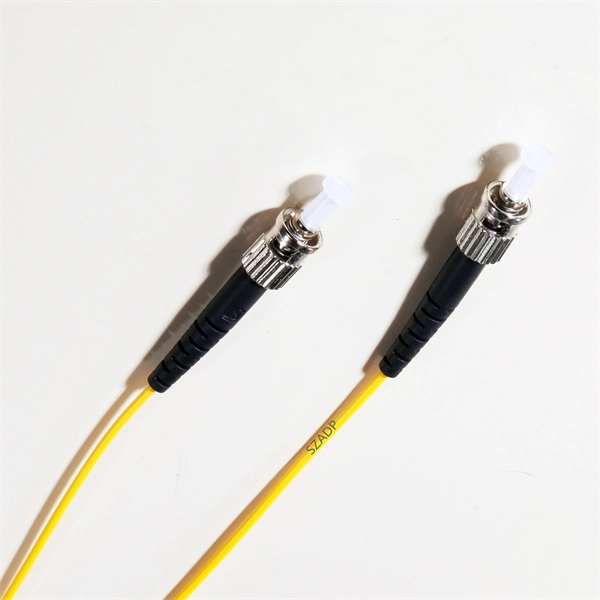
Optical return loss is the amount of light that is reflected back to the source, this reflected light is measured at each connector and splice at each point over the entire fiber link. This is always measured in dB (decibels) and will be displayed as a negative number. The closer the number is to. The polish of a singlemode fiber endface plays a significant role in reflectance. Understand what you need before you specify. The Institute of Electrical and Building the ORL story Electronics Engineers (IEEE) recently Within a fiber-optic channel or path-released new specifications within way. Optical Return Loss (ORL) in fiber optics refers to the amount of light that is reflected back toward the source in a fiber link. ORL is usually expressed in decibels (dB) as a positive value, with. Return loss (RL) is also called reflection loss. When high-speed signals enter or exit a part of an optical fiber, such as an optical fiber connector, discontinuity and impedance mismatch may cause reflection, which is the return loss of an optical fiber. Poor ORL is commonly caused by dirty connectors, poor splices, mismatched connector types, or damaged fibers. ORL is measured using ORL meters. Home Coherent Optics Optical Return Loss (ORL) Explained Comprehensive Guide to Understanding and Managing Back-Reflections in Fiber Optic Systems What is Optical Return Loss (ORL)? Optical Return Loss (ORL) is a critical parameter in fiber optic systems that quantifies the amount of light.
[PDF]
The communication system of fiber optics is well understood by studying the parts and sections of it. The major elements of an optical fiber communication system are shown in the following figure. The ba.
[PDF]

Networks are fundamental to the operation, security and resilience of many organisations. This guidance provides an introduction to the key topics to consider when designing, maintaining, or using networks that need to be secure and resilient. Network security combines policies and technologies to protect systems and digital assets from unauthorized access, misuse, and disruption. By using layered defenses rather than a single control, it ensures data integrity and reliable performance across increasingly complex, distributed networks. Modern IT infrastructure is comprised of various interconnected network components that make communication and resource sharing possible throughout your organization. It ensures systems remain confidential, available, and trustworthy across all digital environments. Its features are: Network security works through multiple protective layers that control. Part of the Cybersecurity Skills Guide — This article is one deep-dive in our complete skills and certifications series. By HADESS Team | February 28, 2026 | Updated: February 28, 2026 | 12 min read Network security fundamentals form the base layer of every cybersecurity specialization. It will also help you apply the NCSC's Cyber security. The foundation of effective network security rests upon several key principles. Each principle is essential in formulating a comprehensive approach to securing a network. (Issa) Confidentiality ensures that sensitive.
[PDF]
An optical spectrometer (spectrophotometer, spectrograph or spectroscope) is an instrument used to measure properties of over a specific portion of the, typically used in to identify materials. The variable measured is most often the of the light but could also, for instance, be the state. The independent variable is usually the of.
[PDF]

The Law on Electricity determines the principles, rules and measures on the organization, operation, management and inspection of electrical activities for the high effectiveness of electricity generation and business operation with the aims to use the natural resource. The Law on Electricity determines the principles, rules and measures on the organization, operation, management and inspection of electrical activities for the high effectiveness of electricity generation and business operation with the aims to use the natural resource. Document prepared by the MLMUPC Cambodia, supported by ADB TA 3577 and LMAP TA GTZ. Article 1 : The purpose of this law is to govern and to prepare a framework for, the electric power supply and services throughout the Kingdom of Cambodia. This law makes an amendment on Article 9. Your browser does not support object tags. By accessing this website or database, users agree to take. The power sector of Cambodia is administered and managed under the Electricity Law which was enacted in February 2001. This law covers all activities related to the supply, the provision of services and uses of electricity and other associated activities of power sector.
[PDF]